VENUS: Visual Editing with Noise Inversion Using Scene Graphs

Thanh-Nhan Vo1,2, Trong-Thuan Nguyen1,2, Tam V. Nguyen3, Minh-Triet Tran1,2
1University of Science, VNU-HCM, Vietnam    2Vietnam National University, Ho Chi Minh City, Vietnam    3University of Dayton, U.S.A.
MMM 2026

Key Contributions

  • Training-free framework with split prompt conditioning — no fine-tuning required.
  • Scene graph integration via MLLM for automatic extraction and refinement.
  • State-of-the-art on PIE-Bench: PSNR 22.45→24.80, SSIM 0.79→0.84, LPIPS 0.100→0.070.
  • 20–30s per image (down from 6–10 min), with 0.87 DINO on EditVal.

Abstract

State-of-the-art text-based image editing models often struggle to balance background preservation with semantic consistency, frequently resulting either in the synthesis of entirely new images or in outputs that fail to realize the intended edits. In contrast, scene graph-based image editing addresses this limitation by providing a structured representation of semantic entities and their relations, thereby offering improved controllability. However, existing scene graph editing methods typically depend on model fine-tuning, which incurs high computational cost and limits scalability.

To this end, we introduce VENUS (Visual Editing with Noise inversion Using Scene graphs), a training-free framework for scene graph-guided image editing. Specifically, VENUS employs a split prompt conditioning strategy that disentangles the target object of the edit from its background context, while simultaneously leveraging noise inversion to preserve fidelity in unedited regions. Moreover, our proposed approach integrates scene graphs extracted from multimodal large language models with diffusion backbones, without requiring any additional training.
Method

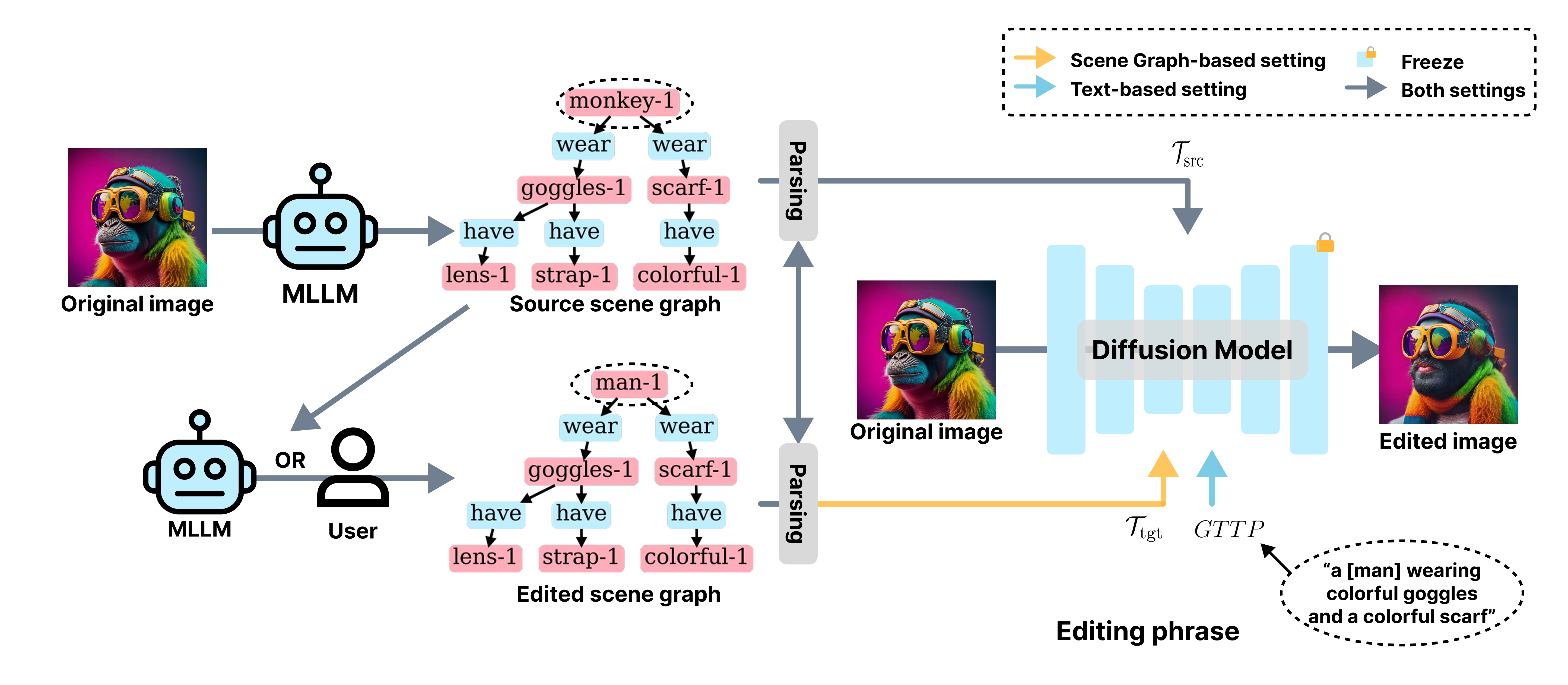
VENUS uses a multimodal LLM to extract scene graphs from images, then applies a split prompt conditioning strategy: a target prompt for edited content and a source prompt for preserved background. This ensures edits are localized while unedited regions remain intact.

VENUS method overview: Scene graph construction, split prompt conditioning, and diffusion-based image editing pipeline.

An illustration of the VENUS approach. A scene graph is constructed from the input image, then edited by either the MLLM or the user. The edited graph is parsed into structured prompts, which condition a frozen diffusion model to edit the image.

Results

Comparison on PIE-Bench

Comparison of different models on background preservation and semantic consistency. GTTP denotes the Ground-Truth Target Prompt used during editing and evaluation.

Method Backbone PSNR ↑ SSIM ↑ LPIPS ↓ CLIP Whole ↑
Text-based Editing Methods
P2P17.870.7110.20925.01
Pix2Pix-Zero20.440.7470.17222.80
MasaCtrl22.170.7970.10723.96
PnP22.280.7910.11325.41
PnP + DirInv22.460.7970.10625.41
P2P + DirInv27.220.8480.05525.02
LEDIT++ (only GTTP)SDv2.123.180.8220.08626.85
VENUS w/ GTTPLEDIT++23.540.8290.08426.89
VENUS w/ GTTPP2P+DirInv27.250.8530.05025.99
Scene graph-based Editing Methods
DiffSG9.350.410.5512.45
SIMSG19.480.700.4020.40
SGEditSDv2.122.450.790.1024.19
VENUS (Ours)LEDIT++24.800.8370.07024.97

Comparison on EditVal

Accuracy is measured using OwL-ViT, and fidelity is measured using DINO (higher is better). Runtime corresponds to the average editing time per image.

Method Accuracy (OwL-ViT) ↑ Fidelity (DINO) ↑ Time per image
Scene graph-based Editing Methods
SIMSG0.110.57
DiffSG0.010.13
SGEdit0.530.836–10 min
VENUS (Ours)0.320.8720–30 sec

Qualitative Results

Scene Graph-Guided Editing Examples

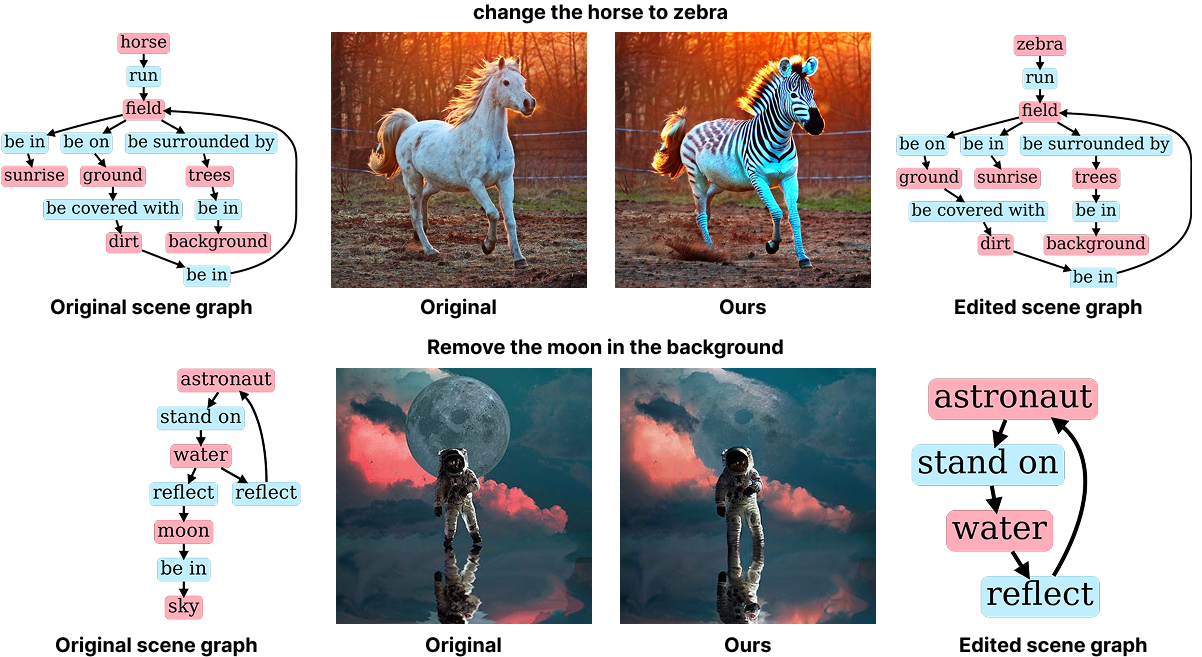
Examples of scene graph guided image editing.

Examples of scene graph guided image editing. Top: changing a horse into a zebra by updating the corresponding node. Bottom: removing the moon by deleting its associated nodes and relations.


Comparison with State-of-the-Art

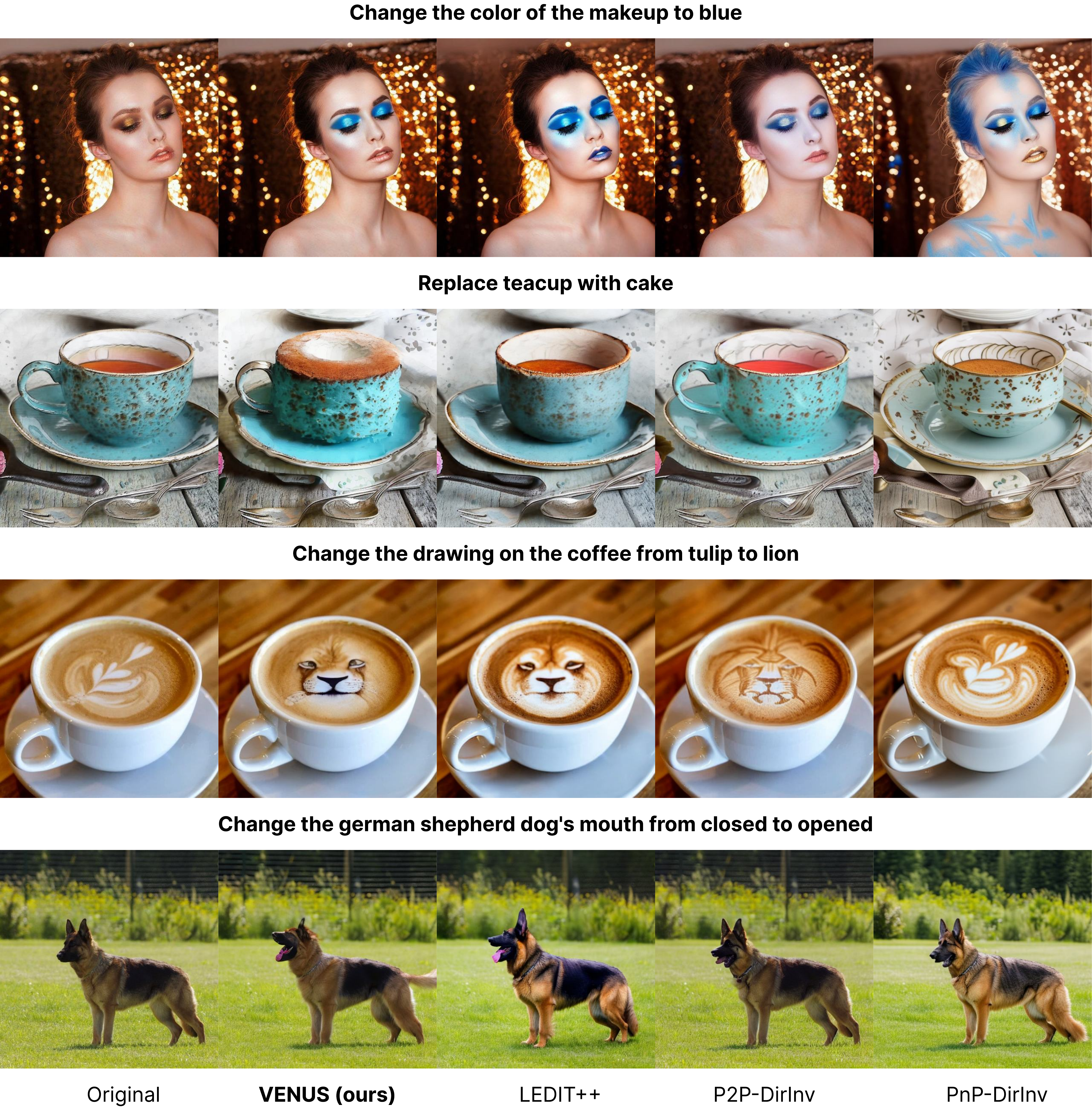
Comparison of editing results across tasks.

Comparison of editing results. Compared to LEDIT++, P2P-DirInv, and PnP-DirInv, VENUS produces edits that are both semantically accurate and visually consistent.

BibTeX

@inproceedings{vo2026venus,
  author    = {Vo, Thanh-Nhan and Nguyen, Trong-Thuan and Nguyen, Tam V. and Tran, Minh-Triet},
  title     = {VENUS: Visual Editing with Noise Inversion Using Scene Graphs},
  booktitle = {International Conference on MultiMedia Modeling (MMM)},
  year      = {2026},
}